 Black friday 50% Off:
A tiered dessert stand can transform a simple dessert table into a focal point guests remember. This guide explains core types and configurations, styling principles, safety and hygiene must‑knows, and how a modular platform like the Momentree Holiday Display Tree can be configured for dessert and cake displays without being traditional servingware.
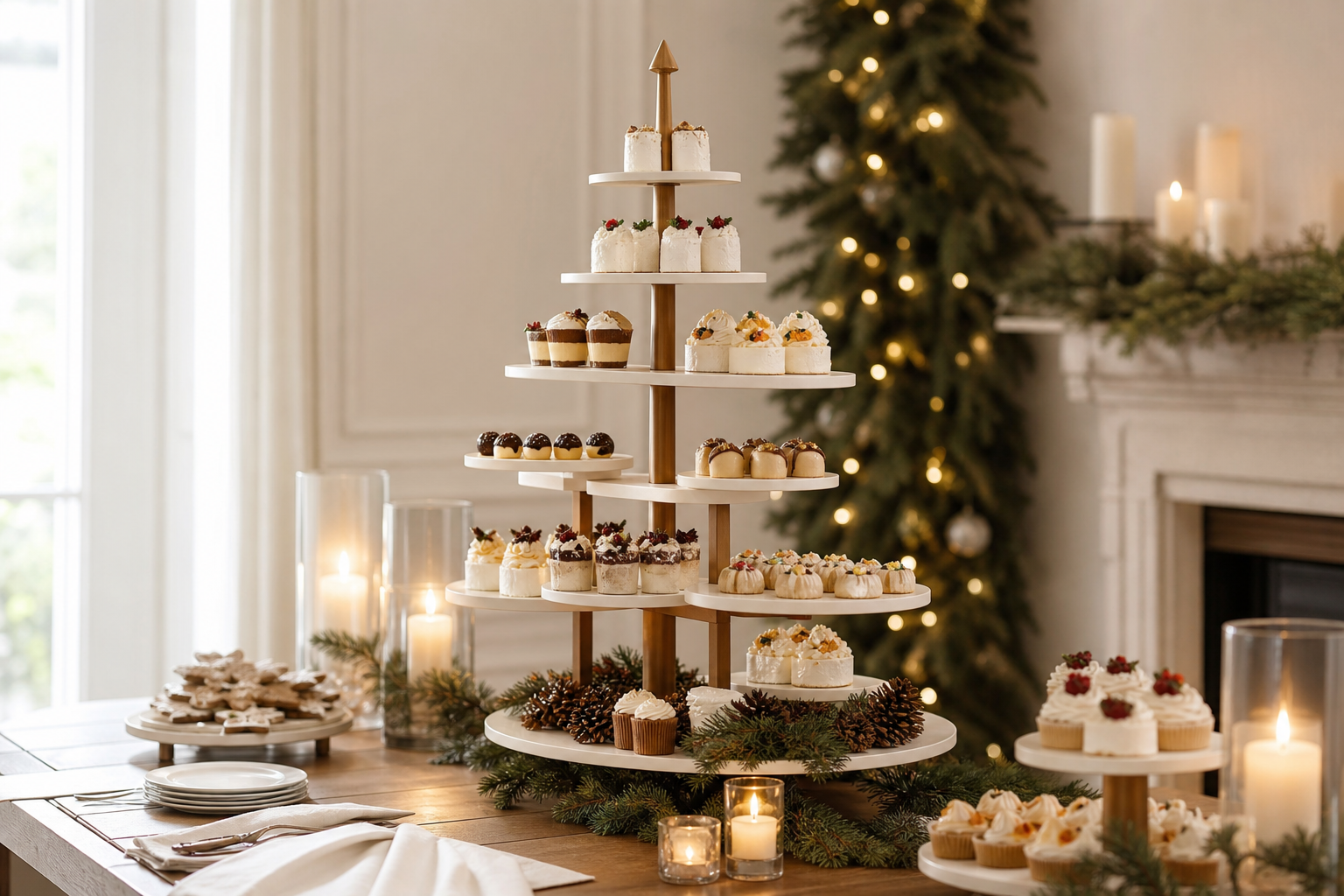
What Is a Tiered Dessert Stand?
A tiered dessert stand is a multi-level display that presents desserts vertically so guests can see and reach items easily. Common forms range from classic two- or three-tier plate stands used at tea service to multi-shelf towers and modular risers for buffets and dessert bars. Modern event styling often mixes traditional stands with larger modular platforms to build height, create a focal point, and coordinate with a theme.
Key Takeaways
- Tiered dessert stands include classic 2–3 tier servingware and larger modular displays; choose the format that fits your menu and space.
- Build visual hierarchy with height, balance, and spacing; map the layout before styling and group like items for clarity.
- Protect food on display following food-safety principles; use liners or plates on surfaces not verified for direct food contact.
- The Momentree Holiday Display Tree is a reusable modular display platform that can be configured for dessert and cake display; it is a display platform, not conventional servingware.
Traditional Servingware vs. Modular Display Platforms
- Traditional dessert stands are typically food-serving pieces with plates and a central post—ideal for intimate teas or small dessert assortments.
- Modular display platforms (including adjustable tiered systems) are event-focused structures designed to be restyled and reconfigured for different occasions. They enable larger, more architectural dessert presentations but are not, by default, food-contact servingware. Use trays, platters, or liners as needed to meet food-safety practices.
Types and Configurations: From 3-Tier to Modular Dessert Displays
Classic 2- and 3-Tier Stands
- Two- and three-tier stands are staples in hospitality and afternoon tea, separating items by course or type. They suit cupcakes, macarons, mini tarts, and petite pastries on small to medium tables.
- A three-tier dessert stand (often called a dessert tower) remains popular for intimate gatherings and service-forward presentations.
Multi-Tier Towers and Buffet Risers
- For larger events, caterers combine multi-shelf towers, pedestal risers, and coordinated platters to maximize vertical capacity and make a dessert bar easy to navigate.
- Materials vary by manufacturer (e.g., metal, wood, acrylic, porcelain). Select for aesthetics, stability, and how well they integrate with your dishes or liners.
Modular and Reconfigurable Systems
- Adjustable or modular stands allow you to vary height and footprint. Build around your menu: fewer tiers for a small celebration; more tiers and wider surfaces for a wedding or gala dessert bar.
- Reconfigure tiers to create a central focal point or distribute multiple focal moments across a longer table.
Choosing the Right Configuration
- Small parties: a single 3 tier dessert stand plus flat platters may be sufficient.
- Medium events: pair multiple three tier dessert stands with low risers for variety.
- Large events: modular, large-format displays create an eye-catching centerpiece that supports many guests moving through at once.
Dessert Display Design Principles & Event Styling Ideas
Build a Clear Visual Hierarchy
- Use height to create a focal point. Place bolder colors or signature items near eye level. Balance textures (glossy glazes vs. matte cookies) and vary sizes for interest.
- Keep spacing comfortable so guests can identify and pick up items without crowding.
Style to Theme and Color
- Unify color accents across signage, florals, ribbons, and dessert finishes. Monochrome palettes look elegant; bold palettes suit playful themes.
- Trends through 2024–2026 emphasize presentation-forward dessert bars, coordinated “cakescapes,” and interactive elements—adapt these ideas to your menu and space.
Plan Guest Flow and Access
- Map your layout before styling. Group like items (e.g., all macarons together) and place utensils, plates, and napkins where they won’t bottleneck traffic.
- Consider symmetry for formal events and intentional asymmetry for modern, organic looks.
Safety and Hygiene Essentials
- Protect food on display with appropriate covers, guards, or cases when needed, and provide serving utensils to minimize direct hand contact.
- Follow time/temperature guidance for perishable items. When in doubt, refresh smaller platters more often.
- If a surface is not verified as a multiuse food-contact material, use food-safe liners, plates, or displayware on top.
Momentree Holiday Display Tree as a Modular Dessert Stand: Features & Fit
The Momentree Holiday Display Tree is a reusable modular display platform that can be configured for dessert and cake display. It is a display platform—not conventional servingware—so use trays, plates, or liners for unwrapped desserts.
Key platform characteristics for dessert display:
- Six round display tiers with MDF tier boards featuring a wood-grain finish.
- A black metal center structure and cross-shaped metal base; the base includes rolling wheels.
- Tier edges include holes that accept removable hooks—useful for attaching non-food décor elements like tags or ribbon accents.
- Adjustable assembly: add or remove tier modules to change height and the number of display levels. In full configuration, the platform is 78 inches tall with adjacent tiers spaced 14 inches apart and tier diameters of approximately 8, 11.8, 17.7, 23.2, 27.2, and 31.5 inches.
- Stated total capacity supports over 220 lbs (100 kg); do not exceed product weight guidelines.
- Built vertically from the base and can be disassembled for flat-pack storage when the event is over.
Explore the platform: the Holiday Display Tree can be restyled for different occasions, including the dessert & cake display use case noted in the user manual.
Practical dessert-display notes for this platform:
- Favor heavier items on wider, lower tiers for stability and place lighter accents higher.
- Use plates or liners on tiers for unwrapped items; reserve the hook-ready edges for décor or signage, not utensils.
- Indoors or covered outdoor use only; secure the structure firmly before event use.
Expert Tips for Tiered Dessert Displays
- Map the menu to the structure. Place high-demand, easy-grab items at mid-height within arm’s reach, with signature pieces at eye level for impact.
- Balance access and stability. Keep the heaviest platters on the widest tiers and avoid overhanging plates that might be bumped.
- Test and refine. Do a full mock-up before guests arrive to confirm spacing, flow, and refill strategy.
- Care and maintenance. Dust the display platform with a soft cloth after use. Remove accessories before storage and keep components flat in a dry area.
- Event safety. Keep any display away from open flames or high heat and supervise children near the structure.
Momentree Expert Tip: For modular displays, assemble only the tiers you need for your menu and venue height. On the Holiday Display Tree, using fewer tiers lowers overall height and concentrates attention on featured desserts while maintaining generous spacing on each level.
FAQ: Tiered Dessert Stands and Modular Display Platforms
What is the main purpose of a tiered dessert stand?
To present desserts vertically so guests can easily see and reach items, creating a focal point and increasing usable display area on a table.
How do modular dessert stands differ from traditional 3-tier stands?
Traditional 3-tier stands are typically servingware for small to medium assortments. Modular platforms are larger, reconfigurable structures built for event-scale displays and styling flexibility. They are display platforms and may require trays or liners for unwrapped foods.
Can I use the Momentree Holiday Display Tree for direct food serving?
It is a modular display platform, not conventional servingware. Use plates, trays, or liners for unwrapped desserts and follow food-safety practices appropriate to your event.
What materials are used in modular display platforms?
Materials vary by manufacturer and design. The Holiday Display Tree uses MDF tier boards with a wood-grain finish and a black metal support structure with a cross-shaped base.
How do I style tiered dessert stands for different events?
Start with visual hierarchy (height and focal point), unify colors to theme, group like items, and plan guest flow. Adjust the number of tiers and risers to suit your menu and space.
Are tiered dessert stands suitable for large gatherings?
Yes. For small events, a single three tier dessert stand may suffice. For larger events, combine multiple stands or use modular, large-format platforms to handle volume and visibility.
How do you clean and maintain modular dessert display systems?
Follow manufacturer care instructions for the structure (e.g., dusting the display platform). For any food-contact trays or liners you add, use a wash–rinse–sanitize–air‑dry process. Store display components flat and dry after disassembly.
Related Guides
- Dessert display inspiration
- Styling modular tiered displays
- Event display tips for weddings
Sources and Further Reading
- WebstaurantStore – Category overview of display risers and tiered displays: https://www.webstaurantstore.com/33831/display-risers-and-display-stands.html
- Restaurantware – Display Stands Buying Guide: https://www.restaurantware.com/blogs/smallwares/display-stands-buying-guide
- Le Cordon Bleu – Inside the art of High Tea (three-tier service context): https://www.cordonbleu.edu/news/inside-the-art-of-high-tea/en
- The Knot – Wedding dessert table ideas: https://www.theknot.com/content/wedding-food-buffet-dessert
- BizBash – 10 Food and Beverage Trends for 2025: https://www.bizbash.com/food-beverage-trends/10-food-and-beverage-trends-to-keep-top-of-mind-at-events-in-2025
- Catersource – State of the Industry 2024: https://www.cater-event.com/food-beverage/catersource-state-of-the-industry-2024-part-5-talking-trends
- Institute of Culinary Education – Pro plating tips: https://www.ice.edu/blog/pro-plating-tips
- Culinary Institute of America – Plating/composition references: https://www.ciaconsulting.org/wp-content/uploads/2025/04/CEIP-Module-I-Contemporary-Flavors-Technique-v.210-CP.pdf
- Barenthal – How to set up a dessert table at home: https://www.barenthal.com/blogs/blog/how-to-set-up-a-dessert-table-at-home
- FDA Food Code 2022 (food display and self‑service principles): https://www.fda.gov/files/food/published/FDA-FoodCode2022-FullDocument-01182023_0.pdf
- FDA – Serving Up Safe Buffets: https://www.fda.gov/food/buy-store-serve-safe-food/serving-safe-buffets
- USDA/FSIS – 2-Hour Rule: https://ask.fsis.usda.gov/article/What-is-the-2-Hour-Rule-with-leaving-food-out
- CDC – Food safety basics: https://www.cdc.gov/food-safety/prevention/
- FDA – FASTER Act (sesame allergen): https://www.fda.gov/food/food-allergies/faster-act-sesame-ninth-major-food-allergen
- FDA – Allergen removal via cleaning methods: https://www.fda.gov/food/retail-food-protection/allergen-removal-and-transfer-using-wiping-and-cleaning-methods-retail-food-establishments
- ServSafe – Cleaning vs. Sanitizing (5-step process): https://www.servsafe.com/ServSafe/media/ServSafe/Documents/Cleaning-vs-Sanitizing.pdf


